
Read
the opening.
The first two chapters of Launch Before Perfect, by Lahiru Himesh Madusanka.
Chapters 1–2 · Printed pages 5–10
Back to the bookPage 5 · 1 of 6


Page 5Open full size
By four o’clock on Friday, most of the work has been done. The agency has designed the pages, answered the client’s questions, and corrected the things that needed correcting. Now somebody has to explain all of that in a report.
The information is around somewhere. A task board contains the official progress. Messages contain the exceptions. The account manager remembers a decision that never reached either place. Last week’s report is copied, its date is changed, and the search begins again.
Maya notices this during the first week of an investigation into small creative agencies. She has already been thinking about software for them. Her imagined product has project management, time tracking, invoicing, a client portal, and a dashboard that makes the whole business look reassuringly under control.
Watching a report being assembled is less glamorous than imagining that dashboard. It is also more revealing. The owner is not searching for a new way to run the agency. She wants to get an accurate account of the week’s work to a client before she goes home.
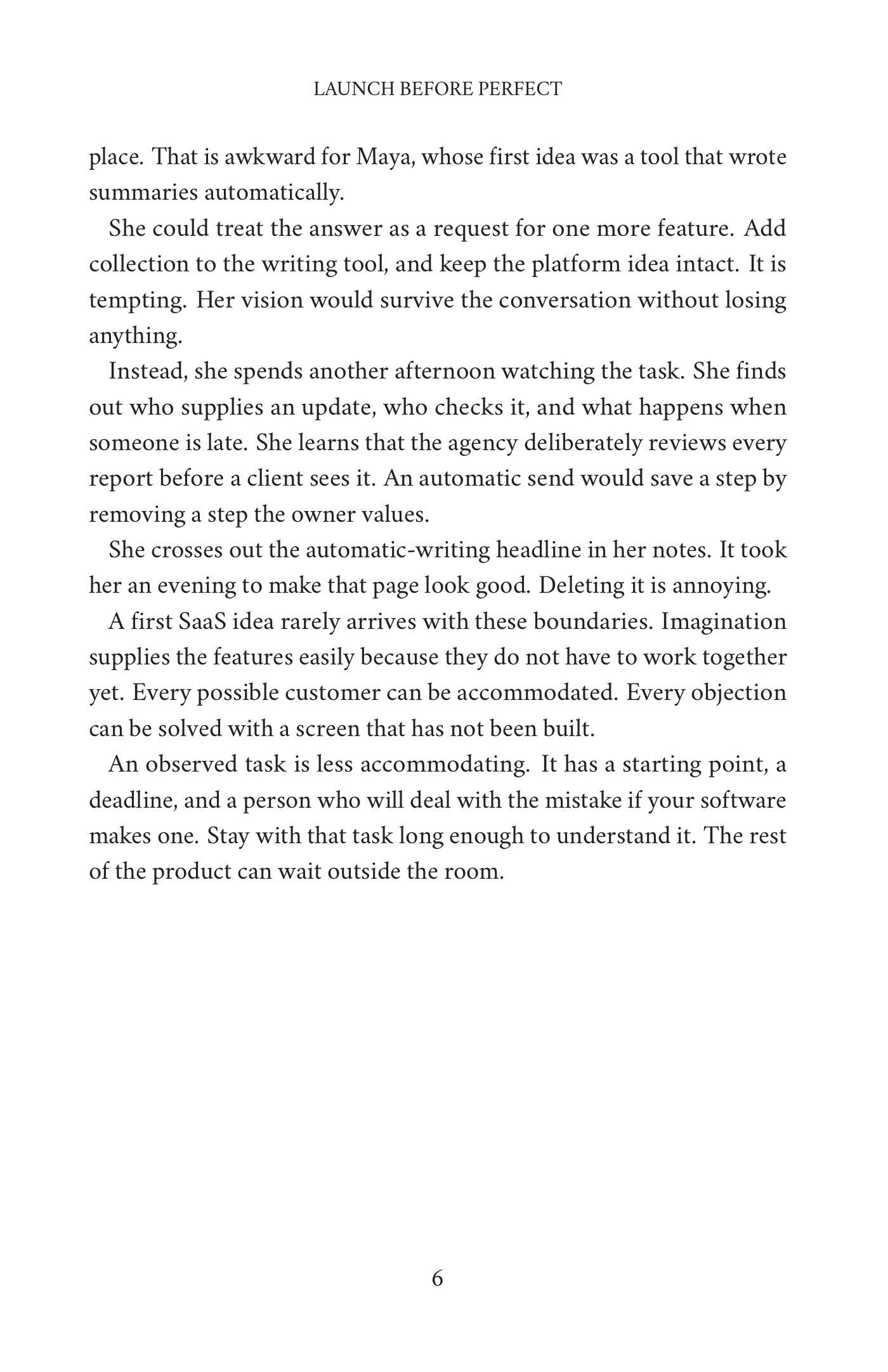
Maya asks which part takes longest. The answer is collecting the updates. Writing the summary is usually quick once the facts are in one place. That is awkward for Maya, whose first idea was a tool that wrote summaries automatically.
She could treat the answer as a request for one more feature. Add collection to the writing tool, and keep the platform idea intact. It is tempting. Her vision would survive the conversation without losing anything.
Instead, she spends another afternoon watching the task. She finds out who supplies an update, who checks it, and what happens when someone is late. She learns that the agency deliberately reviews every report before a client sees it. An automatic send would save a step by removing a step the owner values.
She crosses out the automatic-writing headline in her notes. It took her an evening to make that page look good. Deleting it is annoying.
A first SaaS idea rarely arrives with these boundaries. Imagination supplies the features easily because they do not have to work together yet. Every possible customer can be accommodated. Every objection can be solved with a screen that has not been built.
An observed task is less accommodating. It has a starting point, a deadline, and a person who will deal with the mistake if your software makes one. Stay with that task long enough to understand it. The rest of the product can wait outside the room.
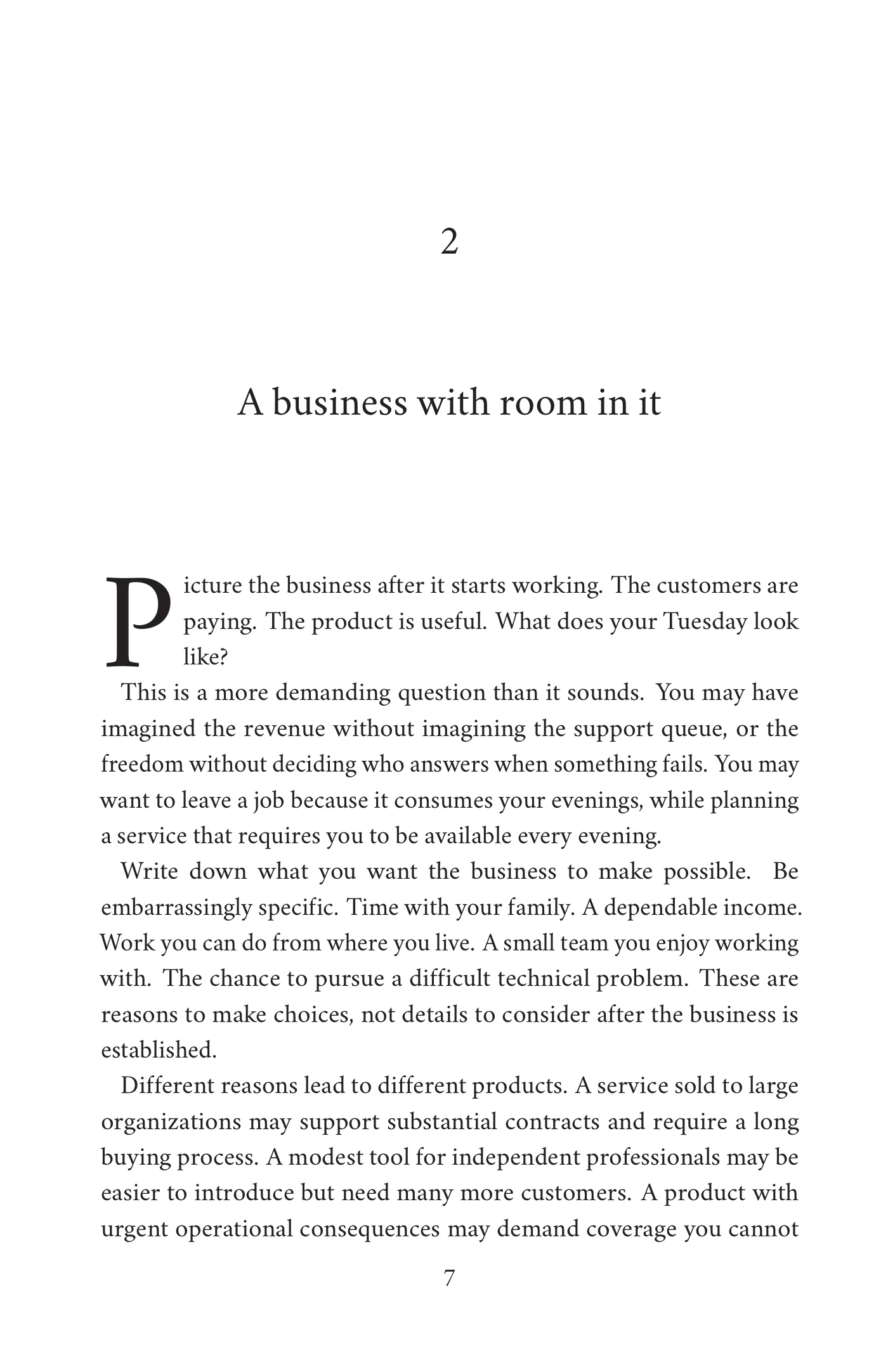
Chapter 2. A business with room in it
Picture the business after it starts working. The customers are paying. The product is useful. What does your Tuesday look like?
This is a more demanding question than it sounds. You may have imagined the revenue without imagining the support queue, or the freedom without deciding who answers when something fails. You may want to leave a job because it consumes your evenings, while planning a service that requires you to be available every evening.
Write down what you want the business to make possible. Be embarrassingly specific. Time with your family. A dependable income. Work you can do from where you live. A small team you enjoy working with. The chance to pursue a difficult technical problem. These are reasons to make choices, not details to consider after the business is established.
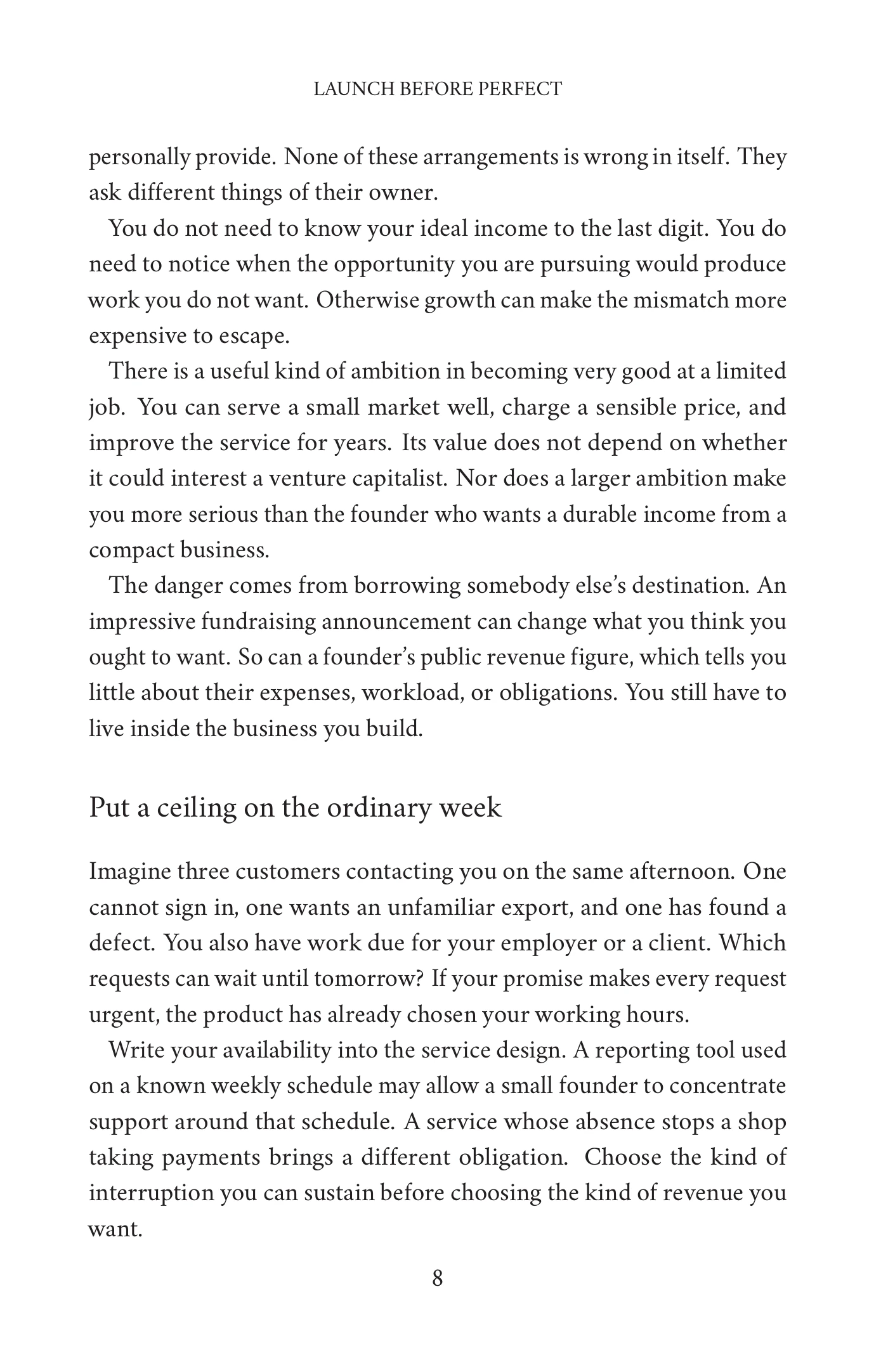
Different reasons lead to different products. A service sold to large organizations may support substantial contracts and require a long buying process. A modest tool for independent professionals may be easier to introduce but need many more customers. A product with urgent operational consequences may demand coverage you cannot personally provide. None of these arrangements is wrong in itself. They ask different things of their owner.
You do not need to know your ideal income to the last digit. You do need to notice when the opportunity you are pursuing would produce work you do not want. Otherwise growth can make the mismatch more expensive to escape.
There is a useful kind of ambition in becoming very good at a limited job. You can serve a small market well, charge a sensible price, and improve the service for years. Its value does not depend on whether it could interest a venture capitalist. Nor does a larger ambition make you more serious than the founder who wants a durable income from a compact business.
The danger comes from borrowing somebody else’s destination. An impressive fundraising announcement can change what you think you ought to want. So can a founder’s public revenue figure, which tells you little about their expenses, workload, or obligations. You still have to live inside the business you build.
Put a ceiling on the ordinary week
Imagine three customers contacting you on the same afternoon. One cannot sign in, one wants an unfamiliar export, and one has found a defect. You also have work due for your employer or a client. Which requests can wait until tomorrow? If your promise makes every request urgent, the product has already chosen your working hours.
Write your availability into the service design. A reporting tool used on a known weekly schedule may allow a small founder to concentrate support around that schedule. A service whose absence stops a shop taking payments brings a different obligation. Choose the kind of interruption you can sustain before choosing the kind of revenue you want.
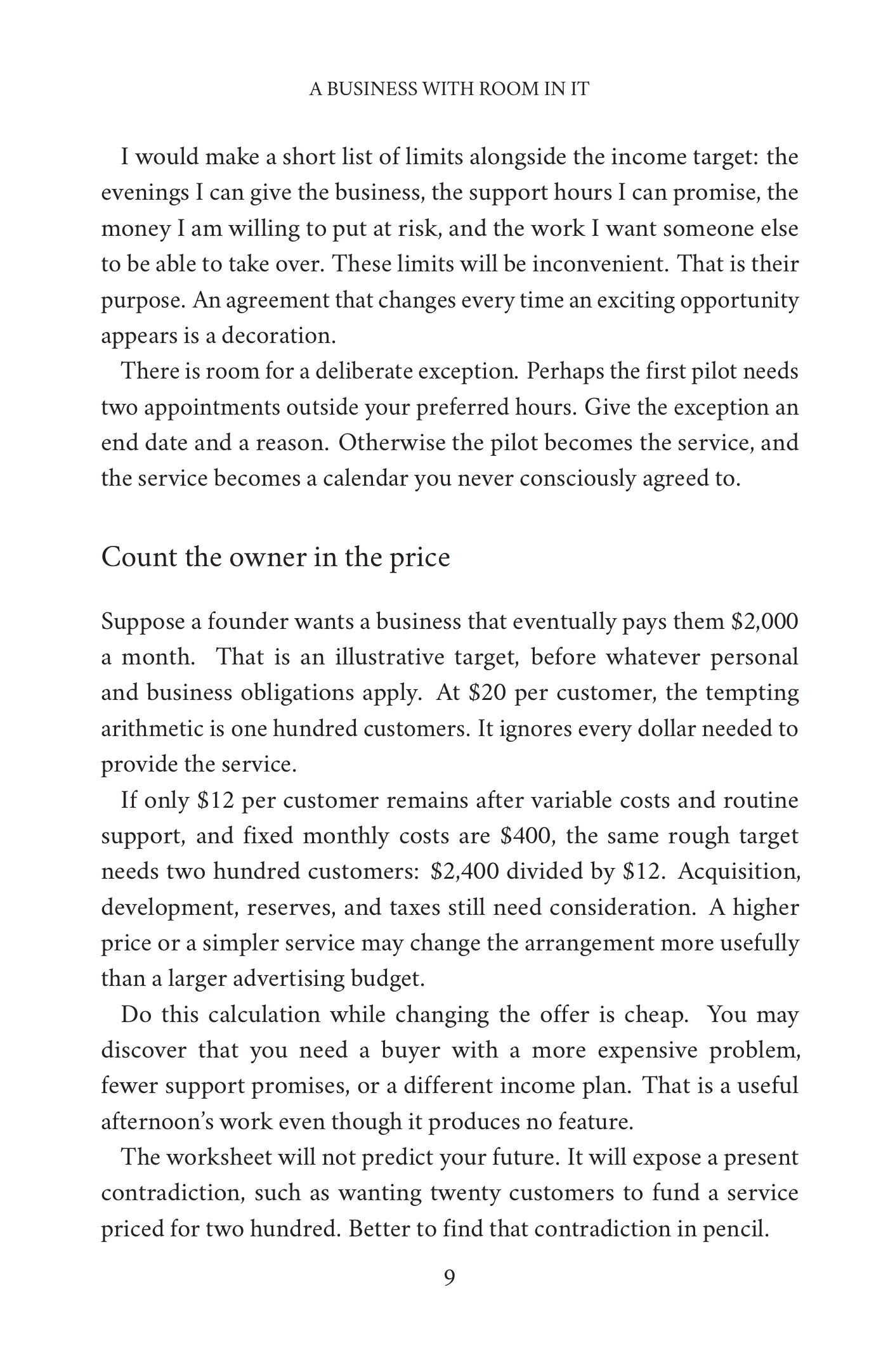
I would make a short list of limits alongside the income target: the evenings I can give the business, the support hours I can promise, the money I am willing to put at risk, and the work I want someone else to be able to take over. These limits will be inconvenient. That is their purpose. An agreement that changes every time an exciting opportunity appears is a decoration.
There is room for a deliberate exception. Perhaps the first pilot needs two appointments outside your preferred hours. Give the exception an end date and a reason. Otherwise the pilot becomes the service, and the service becomes a calendar you never consciously agreed to.
Count the owner in the price
Suppose a founder wants a business that eventually pays them $2,000 a month. That is an illustrative target, before whatever personal and business obligations apply. At $20 per customer, the tempting arithmetic is one hundred customers. It ignores every dollar needed to provide the service.
If only $12 per customer remains after variable costs and routine support, and fixed monthly costs are $400, the same rough target needs two hundred customers: $2,400 divided by $12. Acquisition, development, reserves, and taxes still need consideration. A higher price or a simpler service may change the arrangement more usefully than a larger advertising budget.
Do this calculation while changing the offer is cheap. You may discover that you need a buyer with a more expensive problem, fewer support promises, or a different income plan. That is a useful afternoon’s work even though it produces no feature.
The worksheet will not predict your future. It will expose a present contradiction, such as wanting twenty customers to fund a service priced for two hundred. Better to find that contradiction in pencil.
Put those answers on the calendar. If you want three evenings free, decide which service commitments would consume them. A revenue target is much easier to write than an honest working week.
From Launch Before Perfect. © 2026 Lahiru Himesh Madusanka. All rights reserved.